|
Advertising with us produces results! Increased
sales
Austin, Texas advertising@WasteHeatRecovery.com
"Changing the Way the World Makes and Uses Energy"
Follow us on Twitter:
|
|
Advertising with us produces results! Increased
sales
Austin, Texas advertising@WasteHeatRecovery.com
"Changing the Way the World Makes and Uses Energy"
Follow us on Twitter:
|
Waste Heat Recovery
www.WasteHeatRecovery.com
What is Waste Heat Recovery?
There are more than 500,000 smokestacks in the U.S. that are "wasting" heat, an untapped resource that can be converted to energy with Waste Heat Recovery technologies.
About 10% of these 500,000 smokestacks represent about 75% of the available wasted heat which has a stack gas exit temperature above 500 degrees F. which could generate approximately 50,000 megawatts of electricity annually and an annual market of over $75 billion in gross revenues before tax incentives and greenhouse gas emissions credits.
Waste Heat Recovery technologies represent the least cost solution which provides the greatest return on investment, than any other possible green energy technology or "carbon free energy" opportunity!
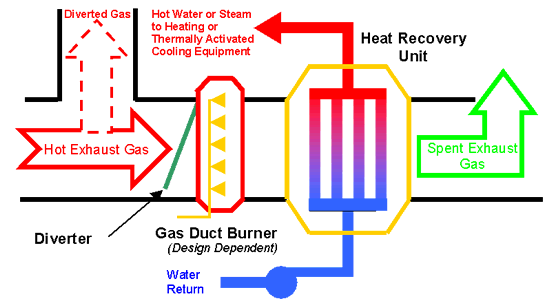
Typical Waste Heat Recovery Installation
|
Heat
Recovery Steam Generator *
Trigeneration
* Waste
Heat Boiler * Waste
Heat Recovery |


advertising@WasteHeatRecovery.com
"The Future of Energy is ' Net Zero
Energy'
and
'Way Beyond Solar!'"
"Net Zero Energy"
to Reach Revenues of $690 Billion / year by 2020
and $1.3 Trillion / year Industry by 2035
Clean
Power Generation
Solutions
CHP
Systems are
a superior clean
power generation solution for data centers,
hospitals, universities, municipal
utility districts and new real estate
developments/subdivisions seeking "net
zero energy" solutions.
When Natural Gas is priced at $4.00/mmbtu, our CHP Systems generate clean power for a fuel cost at about $0.04/kWh. With operations & maintenance added in - we generate clean power for about $0.55/kWh - probably 50% less than your present electric rates, plus we also provide essentially-free heating/hot water as well as the clean power.
CHP
Systems (Cogeneration
and Trigeneration)
Plants
Have Very High Efficiencies, Low Fuel Costs & Low Emissions
The CHP System
below is Rated at 900 kW and Features:
(2) Natural Gas Engines @ 450 kW each on one Skid with Optional
Selective Catalytic Reduction system that removes Nitrogen
Oxides to "non-detect."
The Effective Heat Rate of the CHP System
below is
4100 btu/kW with a Net System Efficiency of 92%.
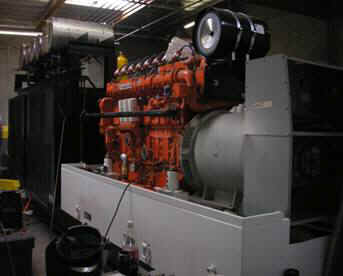
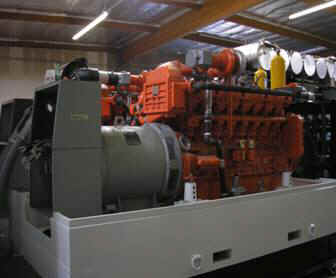
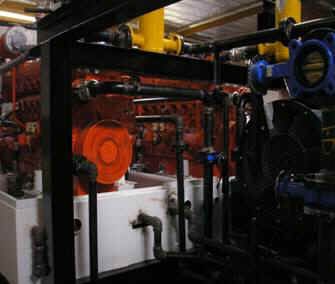
CHP Systems
may be the best solution for your company's economic and environmental
sustainability as we "upgrade" natural gas to clean power with our clean
power generation solutions.
Emissions
Abatement solutions reduce Nitrogen
Oxides to "non-detect" which means our
CHP Systems
can be installed and
operated in most EPA non-attainment regions!
Waste Heat Recovery continued
In some cogeneration and
trigeneration
designs, the exhaust gases can be used to activate a
thermal wheel or a desiccant dehumidifier. Thermal wheels use the exhaust gas
to heat a wheel with a medium that absorbs the heat and then transfers the
heat when the wheel is rotated into the incoming airflow.
A
professional engineer should be involved in designing and sizing of the Waste
Heat Recovery section. For a proper and economical operation, the design of
the heat recovery section involves consideration of many related factors, such
as the thermal capacity of the exhaust gases, the exhaust flow rate, the
sizing and type of heat exchanger, and the desired parameters over a various
range of operating conditions of the cogeneration
or trigeneration
system — all of which need to be
considered for proper and economical operation. Many industrial processes
generate large amounts of waste heat energy that simply pass out of plant
stacks and into the atmosphere or are otherwise lost. Most industrial
waste heat streams are liquid, gaseous, or a combination of the two and
have temperatures from slightly above ambient to over 2000 degrees F.
Stack exhaust losses are inherent in all fuel-fired processes and increase
with the exhaust temperature and the amount of excess air the exhaust
contains. At stack gas temperatures greater than 1000 degrees F, the heat
going up the stack is likely to be the single biggest loss in the process.
Above 1800 degrees F, stack losses will consume at least half of the total
fuel input to the process. Yet, the energy that is recovered from waste
heat streams could displace part or all of the energy input needs for a
unit operation within a plant. Therefore, waste heat recovery offers a
great opportunity to productively use this energy, reducing overall plant
energy consumption and greenhouse gas
emissions. Common methods of
recovering heat include direct heat recovery to the process, recuperators/regenerators,
and waste heat boilers. Unfortunately, the economic benefits of waste heat
recovery do not justify the cost of these systems in every application.
For example, waste heat recovery from lower temperature waste streams (e.g., hot
water or low-temperature flue gas) is thermodynamically limited. Equipment
fouling, occurring during the handling of “dirty” waste streams, is
another barrier to more widespread use of heat recovery systems.
Innovative, affordable waste heat recovery methods that are
ultra-efficient, are applicable to low-temperature streams, or are
suitable for use with corrosive or “dirty” wastes could expand the
number of viable applications of waste heat recovery, as well as improve
the performance of existing applications.
Various Methods for Recovery of Waste Heat Low-Temperature
Waste Heat Recovery Methods – A large amount of energy in the form of
medium- to low-temperature gases or low-temperature liquids (less than
about 250 degrees F) is released from process heating equipment, and much
of this energy is wasted.
Did
you know that 10% of our nation's electricity now comes from "cogeneration"
plants? And
because cogeneration
is so efficient, it saves its customers up to 40% on their energy expenses, and
provides even greater savings to our environment through significant reductions
in fuel usage and much lower greenhouse
gas emissions. Cogeneration
technology is not the latest industry buzz-word being touted as
the solution to our nation's energy woes. Cogeneration
is a proven technology that has been around for over 120 years! Our
nation's first commercial power plant was a cogeneration
plant that was designed and built by Thomas Edison in 1882 in New York. Our
nation's first commercial power plant was called the "Pearl Street
Station." A
Heat
Recovery Steam Generator,
or "HRSG" is a boiler that captures or recovers the exhaust of a
prime mover such as a combustion turbine, natural gas or diesel engine to
create steam. Stated
another way, a HRSG is used to recover energy from the hot exhaust gases
in power generation. It is a bank of tubes that is mounted in the exhaust
stack. Exhaust gases as much as 800 °F to 1200 °F heat these tubes.
Water is pumped and circulated through the tubes and can be held under
high pressure to temperatures of 370°F or higher which can be boiled to
produce steam. Furthermore,
the HRSG separates the caustic compounds in the flue gases from the
occupants and equipment that use the waste heat. HRSG's are found in may
combined cycle power plants. Trigeneration
is the simultaneous production of three forms of energy - typically, Cooling,
Heating and Power - from only one fuel input. Put another way, our trigeneration
power plants produce three
different types of energy for the price of one. Trigeneration
energy
systems can reach overall system efficiencies of 86% to
93%. Typical "central" power plants, that do not need the heat
generated from the combustion and power generation process, are only about 33%
efficient.
Waste heat recovery methods used with industrial process heating
operations intercept the waste gases before they leave the process,
extract some of the heat they contain, and recycle that heat back to the
process.
Conversion of Low Temperature Exhaust Waste Heat – making efficient use
of the low temperature waste heat generated by prime movers such as
micro-turbines, IC engines, fuel cells and other electricity producing
technologies. The energy content of the waste heat must be high enough to
be able to operate equipment found in cogeneration and
trigeneration power
and energy systems such as absorption
chillers, refrigeration
applications, heat amplifiers, dehumidifiers, heat pumps for hot water,
turbine inlet air cooling and other similar devices.
Conversion of Low Temperature Waste Heat into Power –The steam Rankine cycle is the principle method used for producing electric power from high
temperature fluid streams. For the conversion of low temperature heat into
power, the steam Rankine cycle may be a possibility, along with other
known power cycles, such as the Organic
Rankine Cycle.
Small to Medium Air-Cooled Commercial Chillers – All existing commercial
chillers, whether using waste heat, steam or natural gas, are water-cooled
(i.e., they must be connected to cooling towers which evaporate water into
the atmosphere to aid in cooling). This requirement generally limits the
market to large commercial-sized units (150 tons or larger), because of
the maintenance requirements for the cooling towers. Additionally, such
units consume water for cooling, limiting their application in arid
regions of the U.S. No suitable small-to-medium size (15 tons to 200 tons)
air-cooled absorption
chillers are commercially available for these U.S.
climates. A small number of prototype air-cooled absorption
chillers have
been developed in Japan, but they use “hardware” technology that is
not suited to the hotter temperatures experienced in most locations in the
United States. Although developed to work with natural gas firing, these
prototype air-cooled absorption
chillers would also be suited to use waste
heat as the fuel.
What
is "Cogeneration"?
Cogeneration
- also known as “combined
heat and power” (CHP), cogen, district energy, total energy, and
combined cycle, is the simultaneous production of heat (usually in the form of
hot water and/or steam) and power, utilizing one primary fuel such as natural
gas, or a renewable fuel, such as Biomethane,
B100 Biodiesel,
or Synthesis Gas.
What is a Heat
Recovery Steam Generator?
What
is "Trigeneration"?
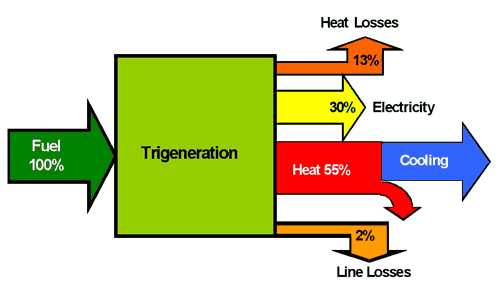
Trigeneration
Diagram & Description
Trigeneration Power Plants' Have the Highest System Efficiencies and are
About 300 % More Efficient than Typical Central Power Plants
Trigeneration
plants are installed at locations that can benefit from all three forms of
energy. These types of installations that install trigeneration
energy systems are called "onsite power generation" also referred to as
"decentralized energy."
One of our company's principal's first experience with the design and development of a trigeneration power plant was the trigeneration power plant installation at Rice University in 1987 where our trigeneration development team started out by conducting a "cogeneration" feasibility study. The EPC contractor that Rice University selected installed the trigeneration power which included a 4.0 MW Ruston gas turbine power plant, along with waste heat recovery boilers and Absorption Chillers. A "waste heat recovery boiler" captures the heat from the exhaust of the gas turbine. From there, the recovered energy was converted to chilled water - originally from (3) Hitachi Absorption Chillers - 2 were rated at 1,000 tons each, and the third Hitachi Absorption Chiller was rated at 1,500 tons. The Hitachi Absorption Chillers were replaced shortly after their installation by the EPC company. The first trigeneration plant at Rice University was so successful, they added a second 5.0 MW trigeneration plant so today, Rice University is now generating about 9.0 MW of electricity, and also producing the cooling and heating the university needs from the trigeneration plant and circulating the trigeneration energy around its campus.

Trigeneration
Chart
Trigeneration's
"Super-Efficiency" compared
with other competing technologies
As you can see, there is No Competition for Trigeneration!
|
Heat
Recovery Steam Generator *
Trigeneration
* Waste
Heat Boiler * Waste
Heat Recovery |
Trigeneration power plants are the ideal onsite power and energy solution for customers that include: Data Centers, Hospitals, Universities, Airports, Central Plants, Colleges & Universities, Dairies, Server Farms, District Heating & Cooling Plants, Food Processing Plants, Golf/Country Clubs, Government Buildings, Grocery Stores, Hotels, Manufacturing Plants, Nursing Homes, Office Buildings / Campuses, Radio Stations, Refrigerated Warehouses, Resorts, Restaurants, Schools, Server Farms, Shopping Centers, Supermarkets, Television Stations, Theatres and Military Bases.
At about 86% to 93% net system efficiency, our trigeneration power plants are about 300% more efficient at providing energy than your current electric utility. That's because the typical electric utility's power plants are only about 33% efficient - they waste 2/3 of the fuel in generating electricity in the enormous amount of waste heat energy that they exhaust through their smokestacks.
Trigeneration is defined as the simultaneous production of three energies: Cooling, Heating and Power. Our trigeneration energy systems use the same amount of fuel in producing three energies that would normally only produce just one type of energy. This means our customers that have our trigeneration power plants have significantly lower energy expenses, and a lower carbon footprint.
What is
a Waste
Heat Boiler?
Waste heat boilers are a special type of boiler that generates steam by removing the heat from a process that would have otherwise been wasted.
Waste heat boilers are therefore able to provide significant reductions in fuel and energy expenses, as well as reduce greenhouse gas emissions.
Waste heat boilers
may be horizontal or vertical shell boilers or water tube boilers. They would be designed to suit individual applications ranging through gases from furnaces, incinerators, gas turbines and diesel exhausts.
The prime requirement is that the waste gases must contain sufficient usable heat to produce steam or hot water at the condition required.
Waste heat boilers
may be designed for either radiant or
convective heat sources.
In some cases, problems may arise due to the source of waste heat, and due consideration must be taken of this, with examples being plastic content in waste being burned in incinerators, carry-over from some type of furnaces causing strongly bonded deposits and carbon from heavy oil fired engines.
Some may be dealt with by maintaining gas-exit temperatures at a predetermined level to prevent dew point being reached and others by soot blowing.
There is increasingly greater interest in onsite power generation plants, including; cogeneration (combined heat and power) plants which incorporate waste heat recovery technologies as well trigeneration plants that also include waste heat recovery technologies as absorption chillers which generate chilled water for air-conditioning.
What is a "Waste Heat Recovery Boiler"?
A
waste heat recovery boiler
is, essentially, a boiler without any energy input. Waste
heat recovery boilers are usually placed on top of a heat source or stack. Inside the
waste heat recovery boiler is a series of tubes that has water inside, that is
continuously circulated. The "wasted heat" is recovered on the hot side, and transferred
to the water inside the tubes of the
waste heat recovery boiler
boiler, and then steam is generated to power a
steam turbine generator, which then generates power.
What
is "Net
Positive Energy?"
Net Positive Energy - when applied to a home or commercial building, means the home or business generates more power and energy than they consume, when measured on an annual basis. The excess power and energy can then be sold/transferred/exported to the grid or to their surrounding neighbors in order to off-set and eventually replace the "dirty brown electrons" generated from highly polluting and inefficient "central power plants."
What
is a "Positive
Energy Building?"
Net
Positive
Energy - A "positive energy building"
produces more energy (from renewable energy sources) than it consumes.
This surplus energy can then be sold to produce an income to a neighbor or
exported to the electric grid for revenue or a credit (see Net
Energy Metering).
About
us:
The founder of the Renewable Energy Institute (REI) was first involved in Net Zero Energy buildings and Solar Trigeneration sm energy system in 2001 - 2002. This started with family-owned real estate developments in Northern and Southern California. This interest was accelerated when REI's founder was introduced to the President of a solar company in Los Angeles and their client, the Audubon Nature Center at Deb's Park (Los Angeles) that was planning to build a new 5,000 sf office and conference center. Except, the new building for the Audubon Nature Center was about 1/2 mile from the end of the power lines and a very costly extension of the power lines to their new facility forced them to consider a solar solution. When the Audubon Nature Center's new 5,000 sf office and conference center was completed in 2003, the facility not only featured the Solar Trigeneration sm energy system - they were awarded one of the first Platinum LEED Awards by the USGBC - and the powerlines were still 1/2 mile away! To this day, 100% of the power and energy for the Audubon Nature Center's building is supplied by the Solar Trigeneration sm energy system - whether at 12 noon, or 12 midnite. (The Audubon's facility also includes a battery energy storage system for back-up power generated by the Rooftop PV panels as well as a thermal energy storage system that stores the excess hot water generated by the evacuated tube collectors).
These early projects led to more client inquiries and engagements with real estate developers, architects and building owners in Southern California, Louisiana and Texas and the advent of a growing Net Zero Energy industry along with Solar Cogeneration sm & Solar Trigeneration sm energy systems. This culminated in a family-owned 200 (Net Zero Energy) home real estate development in Desert Hot Springs which has been approved but not yet constructed.
During this time, the REI's Founder became a volunteer and Advisor to the University of Texas' Solar Decathlon Competition. He coordinated the donation of the same solar thermal system used at the Audubon Nature Center's facility in Los Angeles, for UT's entry in the 2002 Solar Decathlon Competition in Washington, D.C. UT's entry in the Solar Decathlon Competition placed 1st in the domestic hot water competition that year (2002) and 4th overall, out of 20 universities that had entered.
In 2006, after Hurricane Katrina devastated New Orleans, the REI was formed and several of the REI's board members and a Professor from the University of Texas School of Architecture formed a design team to enter the Brad Pitt/Global Green Rebuild New Orleans Competition. Our entry also focused on sustainable building solutions and materials as well as the Net Zero Energy concepts, incorporating once again, a Solar Trigeneration sm energy system.
Today, the REI "Flagship" has chartered the Renewable Energy Institute in Florida, with discussions to open REI state chapters in Arizona, California, Hawaii, Minnesota and Oregon.
The REI supports greater use of Net Zero Energy systems by architects, builders, homeowners and owners of commercial buildings. This includes "upgrading" homes and commercial buildings to Net Zero Energy. The REI provides Net Zero Energy; advertising, business development, conferences, e-commerce, education, marketing, online marketing, public relations, renewable energy, sales and strategic marketing solutions for architects, builders, cities, colleges, HVAC contractors, Net Zero Energy developers, real estate developers and universities.
Net
Zero Energy Buildings Are Next Frontier
http://www.sustainablebusiness.com/index.cfm/go/news.display/id/23361
Net
Zero Energy Market to Become $1.3 Trillion/year Industry by 2035
http://www.navigantresearch.com/newsroom/revenue-from-net-zero-energy-buildings-to-reach-1-3-trillion-by-2035
Net Zero Energy Buildings Are Coming - What About The Buildings Already
Standing?
http://www.forbes.com/sites/justingerdes/2012/02/28/net-zero-energy-buildings-are-coming-what-about-the-buildings-already-standing/
American
Energy Plan sm
www.AmericanEnergyPlan.org
3-5
million new jobs
Net Zero Energy
= Free Power
and Energy!
Biomethane = Fuel Savings of > $2.00/gallon
American Energy Independence
Ends the worst economic depression of all time
Balance
Of Plant - BOP
___________________________________________
www.BalanceOfPlant.com
Balance
Of System - BOS
___________________________________________
www.BalanceOfSystem.com
Battery
Energy Storage - BES
___________________________________________
www.BatteryEnergyStorage.com
Concentrated
Solar Power - CSP
___________________________________________
www.ConcentratedSolarPower.com
Distributed
Energy Resources - DER
___________________________________________
www.DistributedEnergyResources.com
Energy
Investment Banking
___________________________________________
www.EnergyInvestmentBanking.com
Engineering
Procurement Construction - EPC
___________________________________________
www.EngineeringProcurementConstruction.com
Front-end
Engineering Design - FEED
___________________________________________
www.FrontEndEngineeringDesign.com
Enhanced
Oil Recovery
___________________________________________
www.EnhancedOilRecovery.com
Solar Power now "Cheaper than Coal!" sm
Molten
Salt Storage
___________________________________________
www.MoltenSaltStorage.com

NO FOREIGN OIL!
Parabolic
Troughs
___________________________________________
www.ParabolicTrough.com
Power
Purchase Agreements - PPA
___________________________________________
www.PowerPurchaseAgreement.com
Solar
Cogeneration
___________________________________________
www.SolarCogeneration.com
Solar
Trigeneration
___________________________________________
www.SolarTrigeneration.com
Support
Renewable Energy
and America's
Renewable Energy Technologies
resources and companies!
“spending
hundreds and hundreds and hundreds of billions of dollars every year for oil,
much of it from the Middle East, is just about the single stupidest thing that
modern society could possibly do. It’s very difficult to think of anything
more idiotic than that.”
~ R. James Woolsey, Jr., former
Director of the CIA
|
Price of Addiction ### to Foreign Oil |
According to R. James Woolsey, for Director of the Central Intelligence Agency, “The basic insight is to realize that global warming, the geopolitics of oil, and warfare in the Persian Gulf are not separate problems — they are aspects of a single problem, the West’s dependence on oil."
We
support the Renewable Energy
Institute and the American
Energy Plan by donating a portion of our profits to the
Renewable Energy
Institute in their efforts to reduce fossil fuel use through
renewable energy and their goals to end fossil fuel pollution by
reducing/eliminating Carbon Emissions,
Carbon Dioxide Emissions and
Greenhouse Gas Emissions.
The Renewable Energy Institute is "Changing The Way The World Makes and Uses Energy by Providing Research & Development, Funding and Resources That Creates Sustainable Energy via 'Carbon Free Energy,' 'Clean Power Generation' and 'Pollution Free Power' Through Expanding the use of Renewable Energy Technologies."
#WasteHeatRecovery #WasteHeat


"Changing the Way the
World Makes and Uses Energy!"
Waste Heat Recovery
www.WasteHeatRecovery.com
advertising@WasteHeatRecovery.com
WasteHeatRecovery.com
Copyright ©
2002
All rights reserved
